By Sarah Brewer
When creating a film, how do you decide what belongs in the frame and what is more powerful when left unsaid?
Lar: It is totally driven by the story because every story has a different need — it has a different appetite. So, the old adage, does it further the story, does it move the story along? That’s just a rule of thumb for everybody: if it doesn’t move the story along, it shouldn’t be seen and it shouldn’t be heard. Quite often you can move the story along without showing anything. Do we know what happened in Chrissy between the playground and when she wakes up in the future? You don’t know; you get little snippets that Megan and her grandmother found her, but when we get to the ending, we don’t know what happens. Leaving that Hitchcockian imagination to it — of how they got there — that’s good. I think it’s more important what you leave off the screen than what you put on. Invite an opportunity for imagination.
What has filmmaking taught you about people that you don’t think you could have learned any other way?
Lar: Everyone is looking for an opportunity — a method — to just be free. Everybody wants to express themselves, but they’re all so bound up in the bullshit of life. They’re nervous, they are defensive, they’re afraid to be themselves, they’re afraid to explore new things. One of the things that I’ve observed has been how some of my actresses really embrace a part, and lean into it, because they get to do something that they can’t do in real life. They don’t get to kill someone; they don’t get to, you know, to be strong in the way that the film lets them be strong.
I write my parts with particular people in mind to play them, so, I know that they’re strong. I know that they take names and kick butt. So, I give them an avenue to kick butt in a way that they’re not going to get in normal, day-to-day, life. I watch them lean into that, and really express it, and really enjoy it. Even with the people out there that you think, “they’re free to be themselves,” there’s always more. We don’t see the complete picture of anybody. You don’t see the complete picture of me; I don’t see the complete picture of you. If we knew each other for the next twelve years, we would still not know that, right? So, everyone’s looking for freedom to do something that they don’t feel they can do within the confines of daily life.
What is something that audiences consistently notice in your work that you never consciously intended to put there?
Lar: I don’t think I have an answer for that because the thing that people do talk to me about — and I’ve gotten messages from all over the world — is that they feel the emotion. Perhaps, I’ve been lucky that I’ve been able to steer the responses from audiences to what I was trying to do. The sweet spot for short films is seven minutes, not twenty minutes. Twenty minutes is too long. When you’re making shorter films in the five, six, seven-minute range, there’s not a whole lot of extra room in there. You give your message, you tell your story, and you’re there — there’s not a whole lot of room for extra things. And maybe people are picking up on other things that I had not intended that I don’t know about because it does screen in places that I’d never been to. Tucked In has been selected for 62 festivals all over the world. I didn’t go to 62 festivals. I don’t have that many airmiles saved up. So yeah, I don’t think so because I’m not wasting minutes of a film. I’m very much a heart on my sleeve kind of person even though my shields are up all the time. You’ll never really wonder what I’m thinking.
Has making films in New Brunswick altered your perception of what makes a story universal?
Lar: If you make a story emotional, it’s going to be universal. If you try to be preachy, it’s not. I don’t think I’m trying to be preachy with my films. I am sure that there are folks that think I am; that’s up to them. If you’re making a story that’s based on emotion, it’s going to be universal. If you’re trying to play into current trends, current ideas, current culture, it’s not. Like, I don’t want to see a movie about anti-woke this, or anti-fascist that. I am inundated with that all day long. I don’t need to see another movie about that; I’ll just open up Instagram.
It’s Pride month. If your story is about pride, and it has an emotional impact to it, that’s universal. But, if you’re just making it to say, “I made a Pride movie so I can check that box off,” that’s not a universal story, that’s you being self-aggrandizing. Emotion makes stories universal. If you’re trying to pick and choose and check boxes with something that you think someone wants to hear about, think about, watch, that’s not going to be universal.
Here’s another example, why is everyone in North America suddenly all wound up about the FIFA world cup? It’s not really patriotism, it’s emotion. People watch thirty minutes of soccer and then they’re an expert? You know, they’re caught up in that because it’s an emotional thing. That’s what makes it universal — the emotion of it. Not the patriotism, nationalism, that’s not what makes it universal, it’s the emotion of the game.
What scene from your body of work best represents your worldview, and why?
Lar: That’s a tough one because I don’t really make movies about my worldview. I am a fiscal conservative, a social liberal. I am a conservative that doesn’t vote conservative because fuck Pierre Poilievre. My worldview is: this is one world, we do not need to dominate each other, we do not need to lord it over each other. This is one world, this is one planet, one group of people; everybody bleeds red, and everybody ends up in the dirt. So, none of us is any better than anybody else. That’s my worldview, and I haven’t really made anything about that. The golden rule is to do unto others as you want them to do unto you. Whether it’s the teachings of Jesus, or the teachings of Mohammed, or of Buddha — just love each other. And, if you can just do that, everything’s going to be okay. To wrap those things up, the final shot of Chrissy: is it real? Is it her daughter or is it not her daughter? Does she find the backpack? The final shot of Chrissy is laden with emotion — there’s love in it, there’s grief in it, and there’s regret in it, and that is life. Life is love, grief, and regret.
If your entire filmography ended up being remembered for just one idea, what would you want that idea to be?
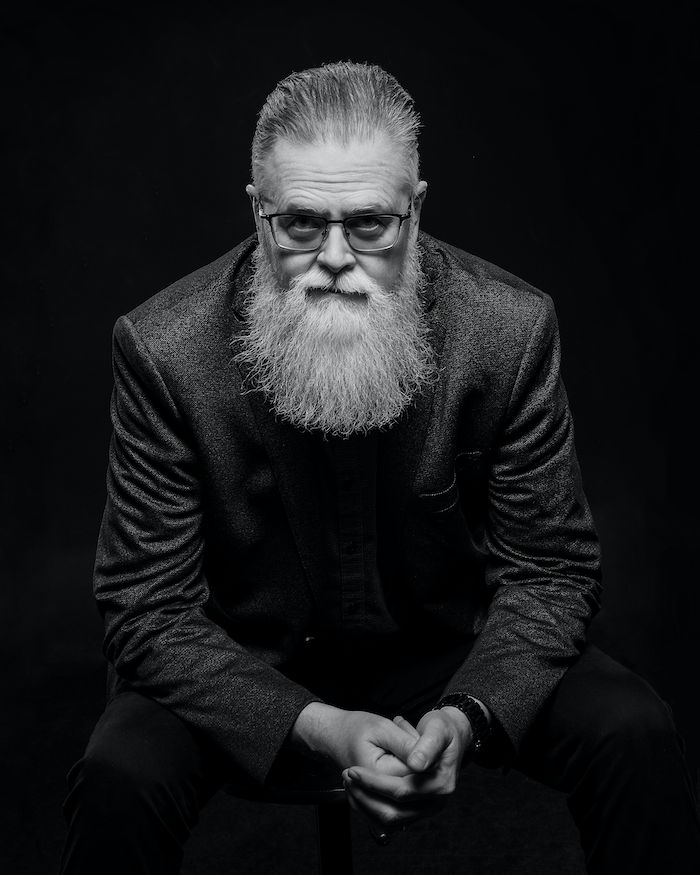
Lar: I’m an old, white, straight guy, and I consider myself a feminist filmmaker. In Chrissy, the principal cast are all ladies. The guys only exist in the movie to die. The women are the heroes. In Tucked In, there’s not a guy on camera. My stories — my more recent stories — are inspired by the fact that I’m a girl dad. I’ve got two daughters that I love very much. I tell the stories that have an emotional impact on me; what does a father feel? So, Chrissy was about a mother, but by God, that’s every father’s fear, too, right? That’s every father’s fear: losing a child. In Tucked In, that’s every father’s fear, too, we just don’t get to express it; we’re not allowed to express it. Despite everything, you know, all the little cool cliches and things, we’re not allowed to express it. So, I get to express some of my things through the female characters in my films. I hope people look at it and go, “that’s a guy that loved his daughters.” I have many daughters: I have two biological daughters, and I have many others that I have just inherited and adopted — if you act in my movie, you become one of my girls, they’re all mine, they’re all my children, and I view them that way. I am proud of all of them. That’s my worldview, you know, love each other. Love your family, take care of your family protect your family, protect the people that become your family, protect the people that aren’t your family, protect everybody. Just be a good person.
The Heart of The Story: An Interview with Lar Collicott